Sunday, June 7, 2020

Have Some Peanut Brittle ~ It's Been Forever!


Wow, it's been forever since I've posted anything here.  I don't know why I haven't.  Due to the whole world pandemic thing and working from home, I have been baking quite a bit...and working of course.  Ahem.

Well, I have decided that I'm going to get back into sharing my recipes with you all.  Or as they say in Texas, y'aaaalll.  So, as my first offering in a long time, I'm going to teach y'aaaaaaalllll how to make peanut brittle.

I know, I know, your Mother or Grandmother told you it was too difficult or took too much time to make peanut brittle, but this way is super easy and fast.  Nearly fail-proof.  I promise.  There's no pesky candy thermometers, barely any stirring, and the results are sure to impress.  Would I stir...steer you wrong?

Fail-Proof Peanut Brittle

1 cup sugar
1/2 cup light corn syrup
1 heaping cup of cocktail peanuts (I used delicious Hubs Peanuts!)
1 tablespoon butter
1 teaspoon vanilla extract
1 teaspoon baking soda

Prepare a baking sheet by lining with a silicone mat or butter heavily.  Do not use waxed or parchment paper.  Your brittle will not come off the paper, and like Alton Brown would say, "That's just not good eats!"

In a microwave safe glass bowl, mix the sugar and corn syrup together with a silicone utensil if possible.  You'll be stirring melted sugar and it doesn't stick to silicone as much.  If not, use a wooden spoon.  A metal utensil would cool the mixture off too quickly and then you'd have more on your spoon than in your bowl.


Pop this into the microwave (1,000 watt is what I have, so yours may differ) and set for 4 minutes on highest setting.  Again, your microwave may be stronger or weaker, so use this recipe as a guideline.  You can always cook a little more, but you can't take away burnt.  Don't be tempted to stop it and stir.  Let this long cooking time run to the end.


Using an oven mitt.  Always be careful because boiling sugar will burn, badly, and deeply.  Remove the bowl from the microwave and immediately stir in the peanuts.  Work fast!  You don't want it to cool off, but please be careful not to burn yourself.  Put the bowl back into the microwave and set for 3-1/2 minutes.

Again, using an oven mitt, remove the bowl from the microwave and immediately stir in the butter and the vanilla.  There will be plenty of bubbling and sizzling.  Remember, hot, Hot, HOT!  Place this back into your microwave and set for 1-1/2 minutes.  Don't be tempted to stop it and stir.

This is where you can adjust the flavor of your brittle.  Once the 1-1/2 minutes have passed, take a look at your brittle.  Better yet, take a whiff.  It's hot though, so be careful!  You can add 15-30 seconds more at intervals and your brittle will darken.

Some people like a lighter, milder brittle.  Where I on the other hand like mine pretty dark and nutty flavored.  Don't get me wrong, I have burnt some batches, but they weren't too bad.  The batch I made here I microwaved an additional 30 seconds and it's light for me.  I probably would have gone an extra 15 seconds.

Finally, with an oven mitt, remove the bowl when you've cooked the syrup to your taste, and quickly stir in the baking soda.  This is where the magic happens!!  The syrup will foam so keep stirring.

Quickly, quickly pour the foaming mixture onto your prepared baking sheet.  You can spread out with your silicone or wooden utensil, but I find it easier if you just tip the baking sheet and let the mixture spread that way.  Let cool completely, break into manageable pieces, and enjoy!

I remember my Grandma Howard always put baking soda in her brittle.  That is what adds the air into the syrup and you get an almost "honeycomb candy" texture.  You can omit the baking soda if you so desire, but I'm not sure why you would really want to!

There are other items you can add to your brittle prior to stirring in the baking soda.  You can add in finely chopped jalapenos or even habaneros.  It's fantastic*!  You may want to experiment adding a little cayenne pepper or even ground cinnamon, or both!

You can also make this with different types of nuts.  I've made this with cashews without changing the cooking times.  You may want to try almonds or even hazel nuts.  I'd be careful with tiny seeds like sesame or sunflower.  Just experiment and adjust times, or even add the seeds in before the baking soda to prevent burning.  Go wild and have fun!

Well, I hope you are glad to see me back, because I'm glad to be back!  When it's just me, Dale, and the puppies, my mind does a bit of racing, but in this day and age of computers, Internet, video chat, etc., it doesn't seem so bad.

Be safe, be kind, and be loving.  Until next time!


*NOTE:  I must warn you, although it's very tasty and a bit addictive, don't eat too much at one sitting.  Without getting too gross or graphic, trust me on this one!  Capsaicin (the element that makes peppers hot) can be a laxative.  I need say no more.

Friday, May 25, 2018

Give Us Our Daily Bauernbrot!


What can I say?  I LOVE BREAD!  And so does most of the world's population!  I've eaten breads from various places around the world, and somethings that the local's pass for "their bread".  But nothing tastes as good to me as a German farmer's bread or Bauernbrot in the German language.  It's not all rye, it's not all white, but a little of both.  I found a recipe online years ago, and I've been making this bread ever since.

There was a day when we never bought bread, because I made our own.  This bread and a sourdough style.  But that is when I had a lot of time on my hands.  Now, I do not have so much spare time, but I do like to make a good crusty loaf of Bauernbrot here and there!

I've never had any problems making my bread at our high elevation of 6,035 feet (1,849-1/2 meters) and it works great at lower elevations as well.  So, I'm sharing my recipe here and I hope you all have the same great success as I have.  Well, after making hundreds of loaves in my lifetime I should have it down!

It's not something that's quick, nor should you try to put it into a bread machine.  Just follow the instructions and you should get a high quality loaf of bread that German's will even rave about!

German Style Farmer's Bread (Bauernbrot)

(makes 1 nice hefty loaf, or you can split dough and make two small loaves)

Starter:
3/4 cup dark rye flour (I only use Bob's Red Mill, but that's just me)
3/4 cup bread flour - do not substitute with all-purpose  (I only use King Arthur, but again, that's just me)
3 Tablespoons barley malt - I think this ingredient is what makes it unique; you could use honey, but why? (you can get it here)
1/2 teaspoon instant yeast (usually get the bread machine or "RapidRise" yeast in the little brown jar)
1-1/2 cups lukewarm water (tap is fine, just don't use ice cold from your fridge door dispenser)

NOW, THIS IS IMPORTANT:  
Put all ingredients in your mixing bowl (I use the bowl from my Kitchen Aid mixer) and stir with a rubber scraper until you have a lovely brown slurry.  Cover the bowl with plastic wrap.  It's always a thing for me to see how tight I can get the wrap.  I try to get it very tight where it doesn't even look like there is any on top!  Oh, back to the recipe and away from my quirks.  Let the mixture sit out for about an hour at room temperature, and then put in your refrigerator.

I find that if I'm getting ready for work, I just mix this up first thing, and then pop it in the fridge before I leave.  This is always good to do on a Friday if you want to bake on Saturday.

Let your starter ferment in the fridge for at least 24 hours.  I've made this with no fermenting, and it's good, but it always seems to be a bit better when I make it this way.

NEXT DAY:
Take your starter from the cold.

Bread Mixture:
2-1/2 cups bread flour (see notes to bread flour above)
2 Tablespoons caraway seeds (I get this in a bulk container on Amazon)
1-1/2 teaspoon Kosher salt (never used any other kind, but I would stay away from table salt)
1/2 teaspoon instant yeast (see notes to yeast above)

1 Tablespoon oil - DO NOT PUT IN MIX NOW (I just use canola oil)

In a small bowl, mix all dry ingredients together with a fork and carefully pour on top of your starter. DO NOT MIX.  Cover again with plastic wrap and let this sit in a warm area for at least 5 hours.  Again, I've made this in a hurry and didn't let this sit for long, but under ideal conditions it's best to let it sit for the prescribed time.

Your starter should be bubbling up and over the flour mixture (see photo).

After your mixture has sit, ADD the oil now and knead on your Kitchen Aid mixer, using the dough hook, on medium-low speed (about setting 4) for 10 minutes.  Add flour by the teaspoons full if the dough is too sticky.  Your dough should be coming off the sides of the bowl and forming a dough blob on the hook.  I also stop the machine and scrape any bits that stick to the sides of the bowl.  Let the dough rest for 10 minutes, and then knead again for another 10 minutes.

I used to do this by hand, but I've learned that the Kitchen Aid is easier and my forearms don't end up looking like Popeye's!

You should have a fairly smooth dough and the sides of the bowl should be clean.  Scrape out of the bowl onto a flour-dusted surface and knead a few times by hand.  This does feel very nice because your dough will really become smooth and elastic.  Those crafty (but tasty) caraway seeds like to jump out during your hand-kneading session, but just use the dough to pick them back up.  Form this into a ball by tucking the sides underneath the ball and keep rotating it as you do this.

You should have a wonderfully silky feeling ball of dough.  Spray your mixing bowl with cooking spray, drop the ball in with smooth side up, and spray the top with more cooking spray.  Cover with plastic wrap and let rise (we call this proofing in the biz!) in a warm area for about an hour.

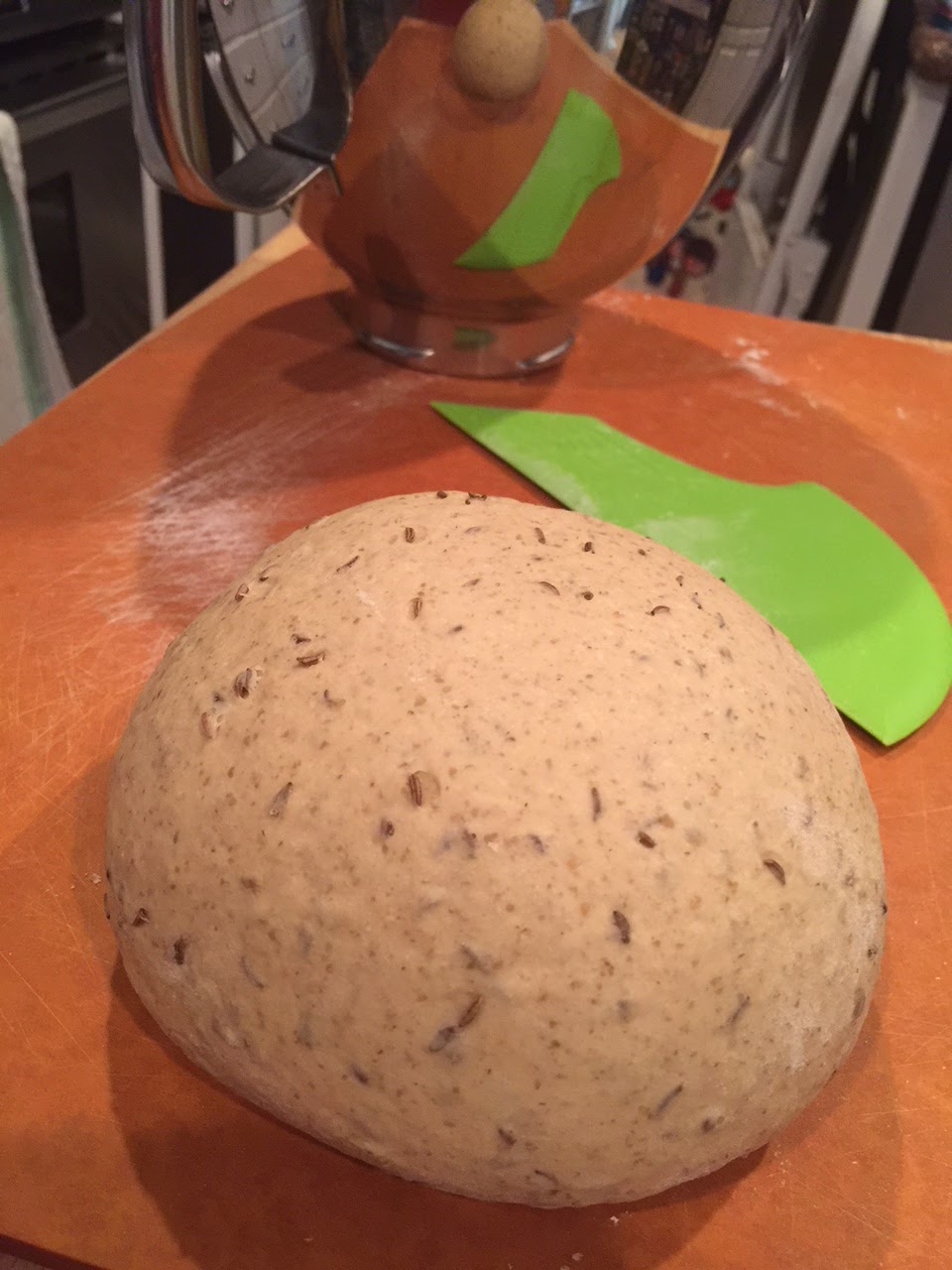
If it's very warm in your house, this may only take 45 minutes or so.  If it's super chilly, this could take up to 2 hours.  You will want the dough to rise until it's doubled in volume in the bowl.  DO NOT over-proof to where your dough is spilling out the top and over the sides of the bowl. I've done this before when I took a nap and forgot to wake up in time!  This is not good because all of the yeast's rising power is nearly spent, and you'll have a hard time proofing it the required second time. Sorry, I only have a picture of the dough before proofing.

Once your dough has doubled: AT THIS TIME, place a large oven stone (or un-glazed tiles) onto the lowest rack of your oven.  Leave room for something metal that can hold water.  I use an old loaf pan.  Pre-heat your oven to 405° F.  Hot!

Then take out doubled dough and knead a few times more and reshape into a ball. Place dough, top-side down into a prepared round brotform, flour and cover to proof for another 45 minutes or so.  The dough should be doubled again, with a nice dome shape springing-forth form the top of the brotform.  Sorry, I did not take a picture of this either.  Bad photographer!

A brotform or bread proofing basket (you can purchase here), is the traditional way of making free standing loaves, but if you don't have one, just scatter a liberal layer of corn meal on a board or flat cookie sheet, place dough on top of corn meal, top-side up, dust dough with flour and cover with a clean cotton tea towel to rise for about 45 minutes.  It should double in size.  The corn meal is very important as it lets you slide your proofed-to-perfection loaf into the oven. You can't bake a loaf of deflated dough, and it's deflated because you couldn't slide it off the board.  Don't skimp on that!

When you are ready to bake your bread, draw a cup of hot water from your tap, and set near your oven.  Carefully turn out your loaf from your brotform onto a corn meal treated board.  If you think it's a bit flat, you can let it sit for another 20-30 minutes, but I usually just bake it from here.

Slash the top of your loaf with a very sharp razor or bread lame (you can purchase the fancy one I have here), or make your own by purchasing safety razors (double-sided) and affixing them to wooden stir sticks.  Slash about 1/2 inch deep, three parallel cuts that are evenly spaced across, turn loaf 90 degrees and repeat.

Slip the bread from the board onto the hot stone, pour the cup of hot water into the heated metal vessel and quickly shut the oven door.  This creates steam to help with an extra rise and makes the outside crusty.  Bake for 15 minutes.

Turn down the oven to 400° F and bake for an additional 25-35 minutes or until the bottom sounds hollow when you thump it and the internal temperature is 190° F or more.  During the baking, I will mist the top of the loaf with water from a spray bottle and rotate it on the stone.  This helps give the loaf a more even bake and the occasional mists of water make the outside VERY crusty.

Remove your fresh baked loaf of bread onto a wire rack to cool.  Do not cut until completely cool.  That is, if you have the will power!  Nothing beats butter on a warm slice of fresh-baked bread!

This bread is delicious fresh, toasted, and it keeps well in a plastic bag.  It also freezes beautifully.  The crumb has a tight, but soft and spongy texture, with a light malty flavor, and accents of anise from the caraway seeds.  The crust is a deeper malt flavor (sometimes I bake at a higher temperature to deliberately "catch" or burn it a bit), and it is so satisfyingly chewy that you'd be crazy to cut off these crusts.

So, that's it!  Intimidating isn't it?  Of course not!

With a little practice and PATIENCE, you too can bake a damned good loaf like this.  Perfect for anytime, and perfect everytime.  Happy baking!


Thursday, May 24, 2018

Soooo Late! But Soooo Worth It!


First of all...I am so sorry for not posting anything on here for, um, two years!!  I don't know if anyone even reads this thing, but I still feel guilty about it.

Lots has happened over the past two years I tell ya!  Dale has officially retired from the Army after 26 glorious years.  Congratulations, Babe!  However, you would think with him being home (finishing up his Master's Degree) that he would be whipping up all sorts of tasty meals, but no, I get home from work and I still hear the "What's for dinner?" question.

Well, we are cheating a bit and have enrolled in Dream Dinners.  It's a bit like Blue Apron or Hello Fresh, but it's way, way easier!  I'll blog more on that another time.  When I do cook, I love using my Instant Pot!

I'm here to give you this great and easy recipe (adapted it from this recipe) for a mega-load of super-delicious Sloppy Joes!  I've made them in my Instant Pot (my latest favorite gastronomical gadget!), but you could just mix up the ingredients and put it all in a good ol' slow cooker and cook on low all day.  But who wants to do that any more??  Not me!

Sloppy Joes were always a favorite of ours when we were kids.  However, my mother had a very basic recipe (ketchup and mustard with a little sugar) and she just always threw it together with no measuring at all.  But, she's never made 5 pounds of Joes at one time.  That's a lot of guess work!

Here is a good recipe that I've tried and tested at work at the U.S. Air Force Academy, on my coworkers.  They are always ready and willing tasters when it comes to my food!

Sloppy Joes for a Crowd - Instant Pot Recipe (6qt or 8qt)

(Served 12 adults with no problems at all)

5 pounds lean ground beef (I used 93%)
2 large onions, diced fine (a food processor would make all your veggie chopping much easier, I'm just sayin'!)
1 large green bell pepper, diced fine
1 large red bell pepper, diced fine
1/4 cup garlic, minced (yeah, that's a lot, but worth it, but use less if you want)
2 1/2 cups ketchup
1/4 cup tomato paste (you can use a little more if you'd like to help thicken more)
1/4 cup soy sauce (not low sodium soy sauce)
1/4 cup Worcestershire sauce
1/4 cup brown sugar
1 heaping tablespoon Dijon mustard
1 1/4 cup water 
2 tablespoons olive oil
Kosher salt & ground black pepper to taste

Using a 6 quart Instant Pot, press "SAUTE" on the highest setting and add the olive oil.  Then crumbled all of the raw hamburger meat into the pot and season to your taste with salt and pepper.  Yes, all!  I guess you could do this in small batches or in a large pan on your stove. Use a wooden spoon or a handy meat thingie like this, and start browning the meat.  This may take some time, but it works and you'll get all of the meat cooked.  You will have to either drain off the juice/fat at the end, or ladle it out.  Either way, you want your meat as dry as you can get it.  Do not turn off your Instant Pot.

Add the onion and saute that while mixing into the cooked ground beef.  Do this for about 2 minutes.  Add the bell peppers and garlic, and again, saute while mixing into the ground beef.  Saute for about 2 minutes more.  Don't worry about making the veggies soft, because the pressure cooking will take care of that!  Add the brown sugar, soy sauce, Worcestershire sauce, and water and mix with the mixture, making sure to scrape the bottom of your pan.

Turn off your Instant Pot and layer the mustard, tomato paste, and ketchup onto the top of your beef mixture.  Put on lid and "PRESSURE COOK" on highest setting for 10 minutes.  Naturally release the pressure for 10 minutes and then rapid release the remaining pressure.  Open the lid and stir well.

If your mixture is looser than you would like it, turn on "SAUTE" on the lowest setting and simmer for 30 minutes, or until you get the right consistency.  If your mixture is too dry, add a little water.

Place your Instant Pot on "SLOW COOK" on the lowest setting and call up the crowd!  I served these with the little Savory Butter Rolls by King's Hawaiian.  Yumo, Sloppy Joe Sliders!

This large and satisfying recipe is great for potlucks, family get-togethers, kid's parties, etc.  There were 12 of us and we I had leftovers to take home to the husband.  Who didn't have dinner ready on the table, of course!  Hope you enjoy this!


Friday, June 3, 2016

Super-Duper Small Gummi Sushi! Yes, you can be a sushi chef too!

Dale and I were running errands today, and we stopped by a great shop near us called, Rocket Fizz.  It's a super-cool candy and soda shop, and they had these gummi kits from Japan.  You made your own gummies and then assembled them to look like different foods.  

Of course I had to get the sushi kit.  I love novel and quirky things like this.  It's very detailed oriented, looks nearly really, and it's miniature!  My favorite criteria!

It's called "Poppin' Cookin' Sushi Kit" and it was really fun to make.  After we downloaded the English instructions from HERE.  The instructions on the box are fine, if you are fluent in reading Japanese!  There are pictures, but in this case, they are not worth a thousand words.

Here is the box.  It's about the size of...well, a box of tampons.  That's really all I could think to compare it to.
This plastic pouch is inside, but don't just rush in and tear it open.  You need to cut where it indicates because you use this as your templates and "plates."
After you cut open the pouch, remove this tray and all of the mysterious packets and hardware.  That little spoon is cute and looks like a tiny spade.
I trimmed the edges of the pouch.
Here are the different color coded packets of mix, the mixing tray, and the squeezy thing, and spoon.
The first thing I did was mix up the rice.  I just used a small spoon to spoon in the minute amounts of water you're suppose to use.  This mixture reminded me of when I attempted to make my own rice cakes.  Now, that was an utter failure, but I won't bore you with the details on that.  Back to our clever sushi!
So, after I made the "Tamago" or "egg omelet," I moved to the "tuna" or "Maguro."  It was nice that you didn't have to work really quickly, but I didn't want to lollygag.  Can you believe that the word "lollygag" didn't show up as a misspelled word?  Ha!
Making the "salmon roe" or "salmon eggs" was THE COOLEST thing I've done all year.  I felt like one of those super-hip molecular chefs.  Just follow the instructions and you cannot go wrong!  The results are amazing, and a little gross, but they do look like fish eggs when you are finished!  This reminded me of that novelty soda in the early 90's called Orbit.  Anyone remember that?
There was a little black stick of candy that you roll out, while using the handy template on the pouch wrapper.  I improvised and was able to make another strip of "Nori" or "seaweed paper" for my tiny omelette sushi.
After all of my ingredients were prepared, it was time to make some sushi!  I took the rice and used the little template to pack together into little cakes for my omelette and tuna.
I also took a piece of the seaweed paper and made into a ring and pushed a little rice into it.  Then I spooned in some of the salmon eggs.  I was thrilled by how real they looked, all plump and shiny!
After I assembled the other pieces of sushi, I assembled the "tuna tower" by using some of the tuna and egg, and chopping them up roughly with my spade spoon.  Then I had to carefully top off some rice that I shaped into a disc.  Working in miniature is a lot harder than you would think!
These were so adorable and merited me pulling out my Nikon and snapping some macro pictures.  The tuna almost looks like the real thing!

I tried one piece and it was so fruity and jellied that it was a bit overwhelming for me.  Something tasted really strong of peach, and well, I loath peach!  Dale gobbled up the remaining "meal."  He even used some the candy mix for "soy sauce."  I kept searching for the wasabi and pickled ginger...but to no avail.

There were other kits, and I think we will get them when Dale's boys, John and Nicholas come out.  This will be a good project for them.  There were burgers, pizzas, and that was all I recalled seeing. 

If you are ever in the Colorado Springs area on the north end of Nevada, you need to check out this candy shop.  I was like a kid in a candy store!!

P.S.  I couldn't get myself to get a "breast milk" flavored lolly.  That was just too...ew, but of course that didn't stop me from taking a picture of it!


Sunday, May 29, 2016

Good enough to eat, but not for me...


I love, love making things with fruit, but I won't eat them.  It's odd because I have an idea what would be a good fruit combination, but I don't like fruit.  Most fruit I've never even eaten.  Crazy, I know!

Even though fruit scares me, I find it can be very beautiful.  Nature is so strange, but yet so alluring!

Dale and I are going to our friend's, John and Val, for a BBQ today.  Of course I wanted to bring everything under the sun, but we limited ourselves to two things.  Dale will be making a cucumber salad, and I made this tart.  

German Fruit Tart

(serves about 12)

Shortcake:
3 eggs
75 grams (3/8 cup) sugar
75 grams (1/3 cup) soft butter
1 packet German vanilla sugar
1 pinch salt
150 grams (1 1/4 cup) pastry flour (half all purpose flour and half cake flour)
1 teaspoon baking powder  

Generously grease and flour a German flan pan.  I recommend that you do this first and have it set aside.  Preheat your oven to 400 degrees F. 

Beat eggs in a large bowl, using a hand mixer at highest setting; add sugars, salt, and soft butter, and continue beating at high speed until frothy.  Sift flour and baking powder together and add and beat until well blended.  Pour batter into the prepared pan and smooth.  This will be fairly thick, so be sure you carefully push the batter into the "moat" of the pan.  This will create the depression in the inverted finished cake.  Bake for about 12-15 minutes or until golden brown and an inserted toothpick comes out clean.  Let the cake cool completely on a wire rack before turning out and assembling.

You can find these specialized ingredients and pan online (Google German Flan Pan) or in German grocery stores, and sometimes the pans show up in thrift stores.  We just take it for granted that we've always had one.  Our pan was from Dale's German mother,  Jenny.  My Grandma Bahls also had one, and made wonderful cakes when we were growing up.  

Tart Filling:
Assorted fruit, sliced; anything that's in season is best, but you can also used canned (I used some canned Mandarin orange slices in the tart pictured)
1 packet Clear Glaze; follow the instructions on the package

Arrange your fruit in a pleasing pattern.  I love this part!  I'm so anal when it comes to getting it just right.

Spoon the hot glaze over top to set the fruit.  Let this cool before serving.

Take a pint of cold heavy cream and add two packets of "Whip It" stabilizer (if you have it), and packet of vanilla sugar.  If not, you can just whip the cream with a little sugar and a few drops of vanilla and serve over the cut slices of the tart.

Enjoy!  I'll just enjoy the pleasure of making something beautiful and delicious for others!

Friday, May 13, 2016

Certified Tested & Perfected: Soft Pretzels v2.0 (with BONUS Sourdough Starter Recipe!)

Yum!  Who doesn't like a good soft pretzel?  Well, I'm sure there may be a few people, but I'm sure they are certified crazy!

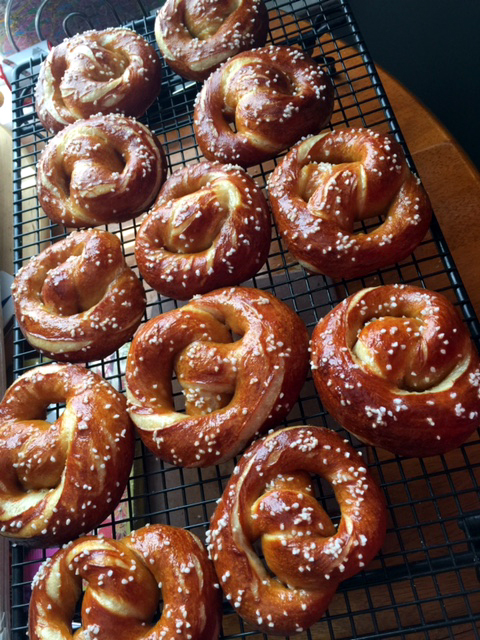
I've made these many times before using some discarded sourdough starter, but this is the first time I've boiled them in a baking soda solution.  I'd have to say the results are stunning.  I would classify this recipe as tested and perfected!  These do not have a very long shelf life in our house, and you will find them as irresistible as we do.  Or maybe not.  We are a couple of pigs in our home.  Pigs for fresh baked soft pretzels!

Sourdough Discard Soft Pretzels

Makes 12 Pretzels

Dough:
3/4 cup lukewarm water
1 cup unfed healthy sourdough starter, straight from the refrigerator (or use fed starter if you like): see sourdough starter recipe below
3 cups unbleached all-purpose flour
1/4 cup nonfat dry milk (I use Bob's Redmill brand, but you can use any)
2 tablespoons (1/2 ounce) non-diastatic malt powder (I use malted milk powder)
1 tablespoon vegetable oil
1 1/2 teaspoons Kosher salt
2 teaspoons instant yeast

coarse Kosher salt; pretzel salt if you can get it

Baking Soda Solution:
10 cups water
2/3 cup baking soda


Mix all ingredients (to exclude the baking soda solution, of course) into a mass of dough.  You will now need to knead the dough – either by hand or a mixer fitted with a dough hook, until smooth.  It should be slightly sticky but not wet.  If it seems dry, knead in an additional tablespoon or two of water.  Shape the dough into a ball, and place it in a lightly greased bowl. Cover the bowl, and let the dough rest for 45 minutes.  The dough will not rise a lot.

Preheat your oven to 350°F, and then put 10 cups water in a large pot and add baking soda.  Bring to a boil while you are rolling shaping the pretzels.

Turn the dough out onto a lightly greased work surface; a silicone rolling mat works well. Fold the dough over a few times with your hands to gently deflate it, then shape it into a rough rectangle.  I love the process of shaping the dough.  It's so relaxing for me.

Score it once lengthwise, and five times crosswise, to make 12 pieces and gently cut the dough into pieces; you don’t want to cut into the silicone mat, if you’re using one.  Or you can eyeball the dough and cut in half, then those two pieces in half, and then each piece into thirds.

Cover the dough you aren't using with plastic wrap, so it doesn’t dry out as you’re working with the individual pieces.  No need to cover if you are seasoned pretzel-shaper like myself!  Haha...yeah, that's what I'm going to keep thinking.

Roll each piece of dough into an 18″ rope (approximate is fine, no rulers needed). Keep the finished ropes covered if you are just learning, so they don’t dry out.

You may find it easiest to roll some of the ropes partway. That way, each has a chance to rest (and the gluten to relax) as you’re working on the other ropes.

Shape into pretzel shapes by making a loop, twist twice, tuck ends behind bottom of pretzel, and lightly press down from the front on top of the ends.  Don't worry about leaving marks since they will boil/bake out.  Just be careful not to get too pushy though and press the dough until it's flat.  Flat pretzels are a no-no here.  Place the shaped pretzels onto parchment-lined or lightly greased (again, I use my silicone mats) baking sheet and get ready to boil them.  Don't be afraid!  I've done this many times and I've never drowned one yet.

The baking soda solution should be boiling.  Drop one pretzel in and boil for 30 seconds.  Take out with a slotted spoon and place back to its place on the baking sheet.  At this time, sprinkle with coarse salt and repeat until one pan is done.  You can put them into the oven and start timer now.  Repeat the same process on other pan and put in the oven and start another timer or do the math.

Bake the pretzels for 25 to 30 minutes, until they’re dark brown.  Remove them from the oven, brush with melted butter, and cool slightly before serving.  They get really shiny and quite lovely.  You almost hate to eat them...almost.
Oh-Em-Gee!  These are so wonderful to eat!  Really.  They are chewy and crunchy and soft and salty and so, so delicious.  You will have a hard time just eating one.

I have tested freezing the shaped unboiled/unbaked pretzel dough, and then taking them out for about an hour before I want to bake them.  This will give you time to get the oven going and the baking soda solution boiling, and your appetite going...

Wild Sourdough Starter 

Makes about 1 cup

This will be more prolific then a couple of bunnies, that is, if you take care of it.  You just have to remember that your new starter will become a living thing, and like all living things, it needs to eat.  You will be it's caretaker since it can't reach out and feed its self, but since you will be feeding it, you will have to throw some of it away.  You don't want a garbage can full of it at the end do you?  Once you establish a healthy starter, you can take the discard from your feedings to make the lovely pretzels above.

This will take time!  Just like when you raise and nurture any living thing. Pulled the following from the King Arthur Flour website.  I say, work smarter, not harder.

Initial Starter:
1 cup whole rye (pumpernickel) or whole wheat flour
1/2 cup cool water

Starter Food:
a scant 1 cup unbleached all-purpose flour
1/2 cup cool water (if your house is warm), or lukewarm water (if your house is cool)

Day 1: Combine the pumpernickel or whole wheat flour with the cool water in a non-reactive container. Glass, crockery, stainless steel, or food-grade plastic all work fine for this.  Stir everything together thoroughly; make sure there's no dry flour anywhere. Cover the container loosely and let the mixture sit at warm room temperature (about 70°F) for 24 hours. See "tips," below, for advice about growing starters in a cold house. 

Day 2: You may see no activity at all in the first 24 hours, or you may see a bit of growth or bubbling. Either way, discard half the starter (4 ounces, about 1/2 cup), and add to the remainder a scant 1 cup King Arthur Unbleached All-Purpose Flour, and 1/2 cup cool water (if your house is warm); or lukewarm water (if it's cold).  Mix well, cover, and let the mixture rest at room temperature for 24 hours. 

Day 3: By the third day, you'll likely see some activity — bubbling; a fresh, fruity aroma, and some evidence of expansion. It's now time to begin two feedings daily, as evenly spaced as your schedule allows. For each feeding, weigh out 4 ounces starter; this will be a generous 1/2 cup, once it's thoroughly stirred down. Discard any remaining starter.  Add a scant 1 cup (4 ounces) King Arthur Unbleached All-Purpose Flour, and 1/2 cup water to the 4 ounces starter. Mix the starter, flour, and water, cover, and let the mixture rest at room temperature for approximately 12 hours before repeating. 

Day 4: Weigh out 4 ounces starter, and discard any remaining starter. Add a scant 1 cup (4 ounces) King Arthur Unbleached All-Purpose Flour, and 1/2 cup water to the 4 ounces starter. Mix the starter, flour, and water, cover, and let the mixture rest at room temperature for approximately 12 hours before repeating.

Day 5: Weigh out 4 ounces starter, and discard any remaining starter. Add a scant 1 cup (4 ounces) King Arthur Unbleached All-Purpose Flour, and 1/2 cup water to the 4 ounces starter. Mix the starter, flour, and water, cover, and let the mixture rest at room temperature for approximately 12 hours before repeating.

By the end of day #5, the starter should have at least doubled in volume. You'll see lots of bubbles; there may be some little "rivulets" on the surface, full of finer bubbles. Also, the starter should have a tangy aroma — pleasingly acidic, but not overpowering. If your starter hasn't risen much and isn't showing lots of bubbles, repeat discarding and feeding every 12 hours on day 6, and day 7, if necessary — as long as it takes to create a vigorous (risen, bubbly) starter. Note: see "tips," below. 

Once the starter is ready, give it one last feeding. Discard all but 4 ounces (a generous 1/2 cup). Feed as usual. Let the starter rest at room temperature for 6 to 8 hours; it should be active, with bubbles breaking the surface. Hate discarding so much starter? See "tips," below. 

Remove however much starter you need for your recipe (no more than 8 ounces, about 1 cup); and transfer the remaining 4 ounces of starter to its permanent home: a crock, jar, or whatever you'd like to store it in long-term. Store this starter in the refrigerator, and feed it regularly; we recommend feeding it with a scant 1 cup flour and 1/2 cup water once a week.

Wednesday, April 27, 2016

Made Lots ~ Posted Not

Look at what I've made since I've been home back on Cache La Poudre Street, and I didn't even write about it.  Tsk, tsk.


Baked Soft Pretzels made from discarded sourdough starter.  Waste never look so good!
Made these tender and fluffy popovers for Easter breakfast.  Dale had never had them before and he proved that it didn't make a difference.  He woofed half of these puppies down.  
It wouldn't be Easter without Deviled Eggs!  I make mine very simple like both of my grandmothers did.  Simple yet delicious.
Super sharp white cheddar mac & cheese.  Yes, those are Ritz crackers on top.  I'm fancy like that.
Brined a plump chicken and roasted it to perfection.
A tiny loaf of Sourdough made from the extras from my Pullman loaf.
This is the small Pullman loaf.  Look at those perfect sandwich slices of bread. 
This is the large Pullman loaf.  I have to cut it in half and freeze it.  It freezes beautifully by the way.
Good old classic German Farmer's Bread.  This is the whopping full loaf. 

My new pans make wonderful mini Frienship loaves to give to friends and family.  Or eat a whole loaf by myself.  Ahem.
This rich and delicious fish soup with assorted fruits from the sea.  That's Monk Fish upfront and centered.  It's called the "Poor Man's Lobster" and I can see why.  The texture was so good!
I helped in the sushi sweatshop at my sister, Dori's house.  Impressive isn't it?